Burial Search settings

CIMS clients are able to control a number of settings for their public-facing Burial Search site!
To change your settings, login to cimscloud.com, click on your cemetery name in the top navigation bar, then "Burial Search settings". If you do not see this option, you may not have permission to edit these settings, or your cemetery might not have purchased the Burial Search addon.
Remember to click "Save settings" if you make any changes, and then refresh your Burial Search site.
Hiding areas & individual spaces
Hebrew date of death & upcoming Yahrzeits
Displaying images to the public
Minimize the information window

The header will appear at the top of every Burial Search page. Likewise, the footer will appear at the bottom of every page.
Click on the "Header/Footer" tab at the top of the Burial Search settings popup to edit the header or footer.
Logo
Choose to display a cemetery or town logo, or show no logo at all.
Header
It is recommended that clients put the name of the cemetery as the "Display name" and the town name and state as the "Tagline". Clients can customize the font family, text bolding, text size, and the line height. The line height is the height between lines and can affect how crowded text looks.
The header will preview in the "Preview" section.
We highly recommend clients show contact information for their cemetery, including the cemetery location and phone number. You can add multiple addresses, phone numbers and emails.
Showing the footer is optional. Each field of the footer is optional and will not show if blank. Clicking on a phone number will attempt to call that number from your device. Likewise, clicking on an email will attempt to write an email and clicking on an address will open Google Maps in a new tab.
Sometimes, you might need to display different text than the address you want Google Maps to navigate to, or show different text for the phone or email. To handle this, we have optional fields for each titled "Alternate address/phone/email display text". An example would be a cemetery with no exact address - you might put latitude and longitude coordinates in the "Address" field but "Intersection of Main St & 2nd St, Mytown" as the display text.
You can have multiple footer contact sections - this is most useful for Burial Search sites with two or more cemeteries.
The header will appear at the top of every Burial Search page. Cemeteries may customize the logo, cemetery name and tagline.
The footer will appear at the bottom of every Burial Search page. We recommend cemeteries add, at a minimum, the cemetery location and a contact phone number.


"About" section

Clients can choose to include an "About" section. This section might have a few sentences about the cemetery, its visiting hours, or policies. Basic HTML can be used to include links to external sites, image embedding, or text styling.
Click on the "Basic settings" tab at the top of the Burial Search settings popup to edit this section.
For help with formatting the "About" section, contact our team.
Webpage link (URL)
Optionally, choose to show a link to a cemetery or town website that will display below the "About" section. This link will be bold and centered, and meant to catch the eye of website visitors.
Preset searches
There are 2 preset search options:
- "List all veterans" displays a small section on the landing page of Burial Search with text and a button to list all veterans present in a cemetery. This option is useful for outside organizations who may place flags on holidays. "List all veterans" should only be turned on if the cemetery's burials have their veteran status accurately filled out.
- "List all available spaces" displays a small section on the landing page of Burial Search with text and a button to list all of that cemetery's spaces that are available. Cemeteries can choose to also display the cost and space type as part of the list. Displaying the space type is most useful for cemeteries with a mix space types, such as ground, columbarium, and crypt.
Click on the "Basic settings" tab at the top of the Burial Search settings popup to make changes to the preset searches.

When first navigating to your cemetery on BurialSearch.com, this veteran section will display if turned on.

Likewise, this section will show on the first page if "List all available spaces" is turned on.


Map customization
CIMS Professional clients
CIMS Professional clients can control the appearance of the map on their Burial Search site as well as the legend. In the "Burial Search settings" popup, click on the "Map" tab. To edit map colors, click on the navy/black "Open map settings for Burial Search" button. Another popup will open, called the Map Layer Settings popup; the best way to get comfortable with these map settings is to play around with them and see what suits your cemetery best. After making changes, click "Save" in the bottom-right. Refresh your Burial Search site to see the map changes you made.
Changing the Burial Search map settings will not affect your individual map settings.
To learn more about the map popup, we have a dedicated page about the map appearance.
CIMS Plus clients
CIMS Plus clients may choose to change the colors of their "Sold with burial" pins. In the "Burial Search settings" popup, click on the "Map" tab Simply click on the colored square next to the space status, and when finished, click "Save settings" in the bottom-right corner of the popup.
CIMS Core clients
In the "Burial Search settings" popup, click on the "Background" tab. This allows CIMS Core clients to change the background color and pattern of their Burial Search site. Several different patterns are available; when finished, click "Save settings" in the bottom-right corner of the popup.
Hiding areas & individual spaces
With Burial Search, you are able to hide individual spaces or entire areas from public viewing and searching. If a space or area is hidden, all burials contained within will not be available to the public. This feature is most useful if a cemetery has a controversial person buried whose gravesite has perhaps been targeted by vandals in the past, or if a cemetery has an "unknown" section where burials are present, but not in their correct location until the cemetery can do additional research.
Hiding a space
Navigate to the space in CIMS using either the map (if CIMS Professional) or the left-hand flyout. In the "Ownership" tab, scroll down; near the bottom is a checkbox labelled "Show this space in Burial Search". If checked, the space and all burials contained within will be available on Burial Search. If unchecked, the space will show as blank on the map (if CIMS Professional) and searching for any individual buried there will not yield any results
Hiding an entire section/block/lot (CIMS Professional only)
Like hiding a space, hiding a section, block or lot will make any burials present not viewable or searchable on Burial Search.
Open the "Burial Search settings" popup by clicking "Utilities" in the top bar, then choosing the option "Burial Search settings" from the dropdown. In the popup, click on the "Map" tab. Scroll down to the "Hidden areas" section. Choose a section, then click "Add to hidden list" to hide an entire section. Likewise, choose a section and block to hide an entire block. Finally, choose a section, block, and lot to hide an entire lot. Remember to click "Save settings" to apply your changes to your Burial Search site.
Note: Some cemeteries will not have the "Lot" option.
Un-hiding a section/block/lot (CIMS Professional only)
To un-hide a section/block/lot, click on the red X next to its entry under "Hidden area list". Remember to click "Save settings".
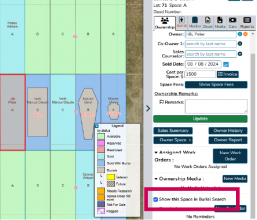
Hiding an individual space is done by checking or unchecking the "Show this space in Burial Search" option in the "Ownership" tab.
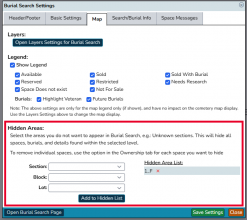
In CIMS, hide an entire section, block or lot using the "Hidden areas" feature. In this case, we have chosen to hide the entirety of Block "F" in section "1".
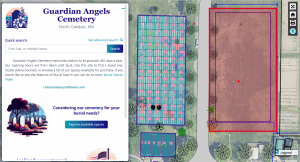
In Burial Search, we can see the entirety of block F (highlighted in red), which should have graves and burials present, is now hidden. Note: The red highlighting will not be present if your cemetery uses this feature.


Burial information
Customize what information appears when a visitor to Burial Search pulls up a buried individual, including birth dates, death dates, sex, veteran information, and more.
Click on the "Search/burial info" tab at the top of the Burial Search settings popup. Underneath the "Search/burial display information" are several collapsed headings; click on them to expand them. Check or uncheck options to choose what information will appear to the public. Options that are checked will appear in a list; drag and drop these options to change the order.
Does your cemetery want to show information that is not available in these dropdowns? Contact our team.
Information in Burial Search will only display if it has been filled out in CIMS. For example, say a cemetery has chosen to display birth dates. If a buried individual does not have a birth date entered in CIMS, rather than showing a blank field and no information in Burial Search, the "Birth date" field will not appear.
Name display
Control how names appear in Burial Search with the "Name display" section. Choose to include an individual's modifier/honorific, the format of their name, and suffix. If the "List all veterans" preset search is turned on, you can choose to include a veteran's rank, branch and/or war in the veterans list. The rank/branch/war will not show up in the standard search, only the "List all veterans" list.
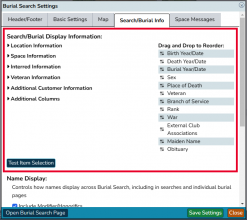
In the "Search/burial info" tab, the information displayed to the public about a buried person can be easily customized (here highlighted in red).
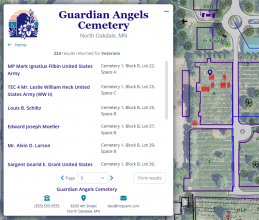
In the "Burial Search settings" popup, in the "Search/burial info" tab, you may choose to show a veteran's rank/branch/war. This veteran info will only show up if the preset search "List all veterans" is chosen by website users.
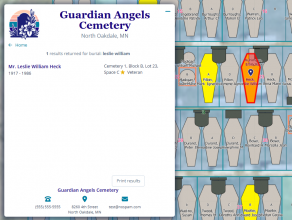
If a normal quick search is done for Leslie Heck, the veteran information that previously displayed with the list of veterans is not shown.


Hebrew date of death & upcoming Yahrzeits
Burial Search is able to show the Hebrew date of death as well as upcoming Yahrzeits. You will need to have Hebrew dates enabled for your cemetery; contact our teamto enable this feature.
To show the Hebrew date of death and, optionally, upcoming Yahrzeits, click on the "Search/burial info" tab at the top of the Burial Search settings popup, then scroll down to "Yahrzeit options". If the "Display Display Hebrew date of death" checkbox is checked, the Hebrew date of death will display to the public in Burial Search. When checked, an additional field will appear, "Number of Upcoming Yahrzeits to Display". This field is optional, and will display up to 10 upcoming Yahrzeit dates in the Gregorian calendar.
When enabled, visitors to BurialSearch.com will see the Hebrew date of death and the number of future Yahrzeits you specified in your settings. This information will display in a dedicated section below the buried person's name and other information.
I don't see a date of death or upcoming Yahrzeits for a buried person?
BurialSearch.com relies on the information in CIMS being complete. Check if this person has a date of death. See recording death dates if CIMS Professional, recording death dates if CIMS Core or Plus, to learn how to record a date of death.
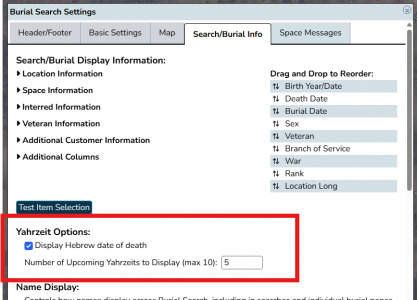
In CIMS, specify if you want to display the Hebrew date of death and upcoming Yahrzeits in the "Search/burial info" tab.
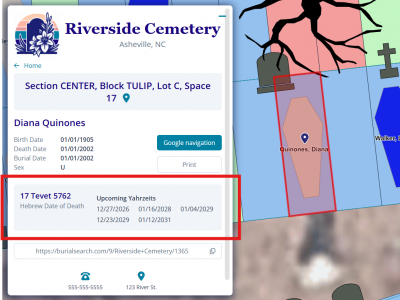
In Burial Search, this information will display in its own section if the buried person has a death date recorded in CIMS.


Hide the advanced search
Some cemeteries may want to hide the advanced search, where Burial Search users can search by using certain filters. These filters correspond to the information you choose to show to visitors when they look at the information of a buried individual (see above, burial information).
An example would be if your local headstone manufacturers are preying upon the families of recently-deceased individuals by searching for burials by date. We hope this is not the case for your cemetery, but if it is, consider hiding the advanced search feature.
Click on the "Search/burial info" tab at the top of the Burial Search settings popup, then scroll down to "Advanced Search" to turn this feature on or off.
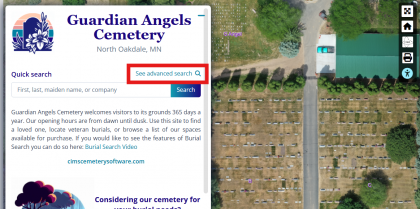
By clicking on "See advanced search", visitors to BurialSearch.com can access the advanced search section.
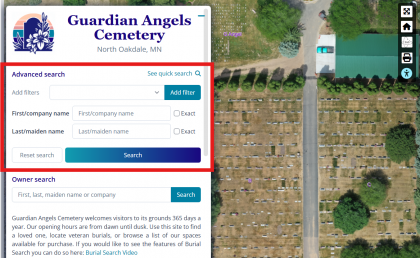
The advanced search section has filters that correspond to the information your cemetery is choosing to show about buried individuals.


Search by owner
Searching by owner will allow website visitors to search for space owners by name. This is most useful for cemetarians wanting to reassure customers that they do have a record of their space purchase, and said purchase is viewable on a public website they can access themselves. If turned on, the owner of a space will also appear as part of the information shown when viewing a burial.
Click on the "Search/burial info" tab at the top of the Burial Search settings popup, then scroll down to "Search by owner" to turn this feature on or off.
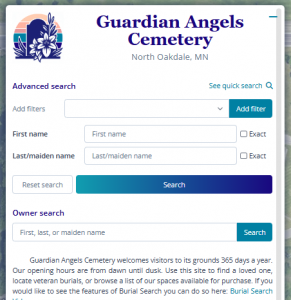
By clicking on "See advanced search", visitors to BurialSearch.com can access the "Owner search" option.
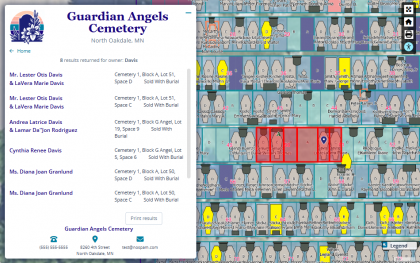
A list of relevant results will display; website visitors can navigate around the map to see where these owner spaces are located (Professional only).
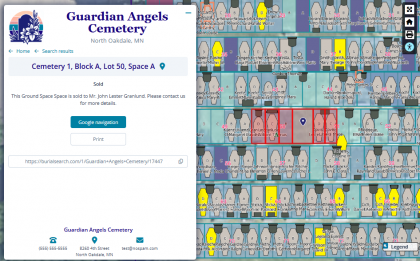
CIMS clients can customize a "Sold" space message to display the owner & co-owner names.


Space messages
Clients can customize the messages that appear when a space is loaded. This can be useful if a cemetery wants to encourage space sales by including a custom message, explicitly display the reason why a space might be restricted, display owner information for "Sold" spaces, and more.
Click on the "Space messages" tab at the top of the Burial Search settings popup. For each status, there are two options:
- The status corresponds to the space status in CIMS (Available, Sold, Restricted, etc.). You can choose to display or hide the space status.
- The message appears below the status (if status is turned on). The message can be a default or custom message. If "None" is chosen, no message will show. Space statuses will have sub-options; for example, for an "Available" space, clients may choose to include the cost of an available space and its type.
Core & Plus -vs- CIMS Professional
- CIMS Core and Plus clients can only customize the messages for "Sold" and "Available" spaces. They are only able to see a sold space and its associated message if they have "Search by owner" enabled and are performing an owner search. Likewise, they will only see an available space and its associate message if they have the "List all available spaces" preset search enabled and are looking at the list of available spaces.
- CIMS Professional clients will have more options; in addition to "Sold" and "Available" spaces, they are able to specify messages for "Restricted", "Reserved", and any custom space statuses they have.
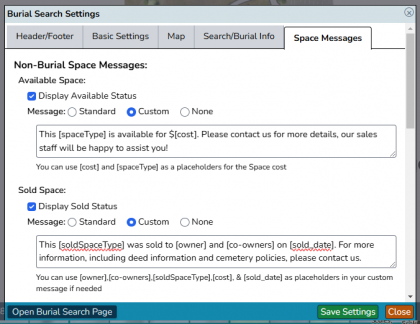
In the above, this cemetery has chosen to show the status for "Sold" spaces as well as a custom message. Note that information like the sold date can be included by using special formatting - this information is pulled directly from CIMS.
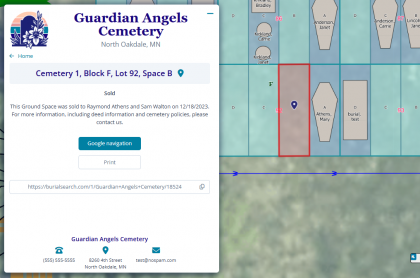
Looking at a "Sold" space in Burial Search, we can see the space status displayed (in bold) and underneath, the custom message.


Displaying images to the public
Clients may choose to display images to the public, including photos of headstones, PDF's of obituaries, and so on.
Navigate to the image you wish to display. In the upper-right corner of the image, a reddish-brown business card icon should be present. Click on this icon once; it will turn green, indicating that the image is now visible to the public on Burial Search. Colorblind users can hover over the icon for a text description.
To remove the image from public viewing, simply click this same icon again. When the icon turns reddish-brown, it is no longer publicly available.
Use caution when choosing which images to display to the public, ensuring sensitive information such as social security numbers, phone numbers, addresses, etc. are not present.
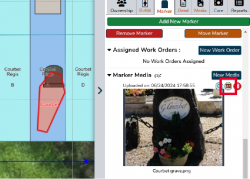
To make an image/PDF available to the public, click on the business card icon in the upper-right of the image.
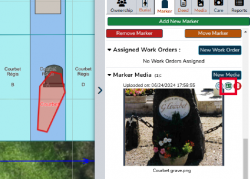
After clicking on it, the icon will turn green. This indicates the image/PDF is now available for public viewing on Burial Search.

Closeup of the icon. Red/brown = not available to the public, green = visible to the public. Colorblind users can hover for a text description.
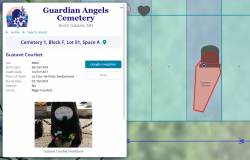
In Burial Search, we now see the image showing up for this buried individual.


Minimize the information window (CIMS Professional & Plus only)
Clients have the option to minimize the information window so that the Burial Search map fills the screen on desktop and most tablets.
Click on the "Basic settings" tab at the top of the Burial Search settings popup. Scroll down to the "Main window minimize" section, and check or uncheck the option "Allow main window to be minimized".
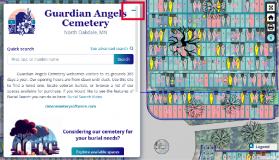
Seen here in the red box, the minimize button will appear in the upper-right corner of the information panel.
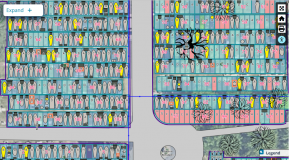
Once minimized, the map will now fill the screen. To show the information panel again, click on the "Expand" button in the top-left corner of the screen.

